DFG Priority Program Initiative: Biosignal-informed Hybrid Intelligence - Balancing Autonomy, Competence, and Performance (SYMBIO)
As AI takes over more cognitive work, the central question is no longer whether humans collaborate with AI, but how this collaboration should be designed. Hybrid intelligence is widely expected to improve task performance and decision-making. Whether it truly delivers this utility across domains, however, depends on careful interaction design, and on recognising that utility has two horizons: the short-term need for task performance, and the long-term need for symbiotic growth of both interacting components. This creates trade-offs that current systems navigate largely blind. Handing core cognitive tasks to AI can raise immediate performance while eroding the competencies and the intrinsic motivation people need to remain capable partners, whereas keeping humans involved for its own sake forfeits real gains. Autonomy, competence, and performance are therefore not separate concerns but a balance to be struck, task by task and over time.
We are preparing a DFG Priority Programme proposal that addresses this challenge through biosignals. Because humans interact with the world through physical, cognitive, and affective processes, biosignals offer a continuous, real-time window into otherwise hidden states such as attention, workload, stress, and fatigue, across the central, autonomic, and somatic dimensions of the nervous system. The programme thus pursues a new generation of biosignal-informed hybrid intelligence: human-AI collaboration systems that perceive the user's cognitive and affective state and use it to calibrate the division of labour in real time, deciding when the AI should step back, provide support, or actively solicit human expertise.
The programme is organised in two complementary streams, a technology stream on biosignal processing and adaptive AI systems, and a human stream on user states, interaction design, and their effects on people. Within these, we currently foresee three research areas: processing biosignals and recognising user states, including the open infrastructure that makes such work accessible across disciplines; designing biosignal-adaptive systems for human-AI collaboration; and understanding how autonomy, competence, and performance can be balanced, including over longer periods of use. Realising this vision requires close interdisciplinary collaboration across computer science, information systems, psychology, and human factors.
If the programme is established, the DFG will issue a call inviting researchers to submit individual project proposals within the programme. We would therefore like to hear from researchers who could envisage submitting a project proposal to such a call, and we warmly invite you to join one of our upcoming round-table events.
Core Organization Team:
- Prof. Dr. Alexander Maedche, Karlsruhe Institute of Technology (KIT)
- Prof. Dr.-Ing. Tanja Schultz, University of Bremen
- Dr. Michael T. Knierim, Karlsruhe Institute of Technology (KIT)
- Prof. Dr. Verena Nitsch, RWTH Aachen
- Prof. Dr. Albrecht Schmidt, LMU Munich
Upcoming Activities:
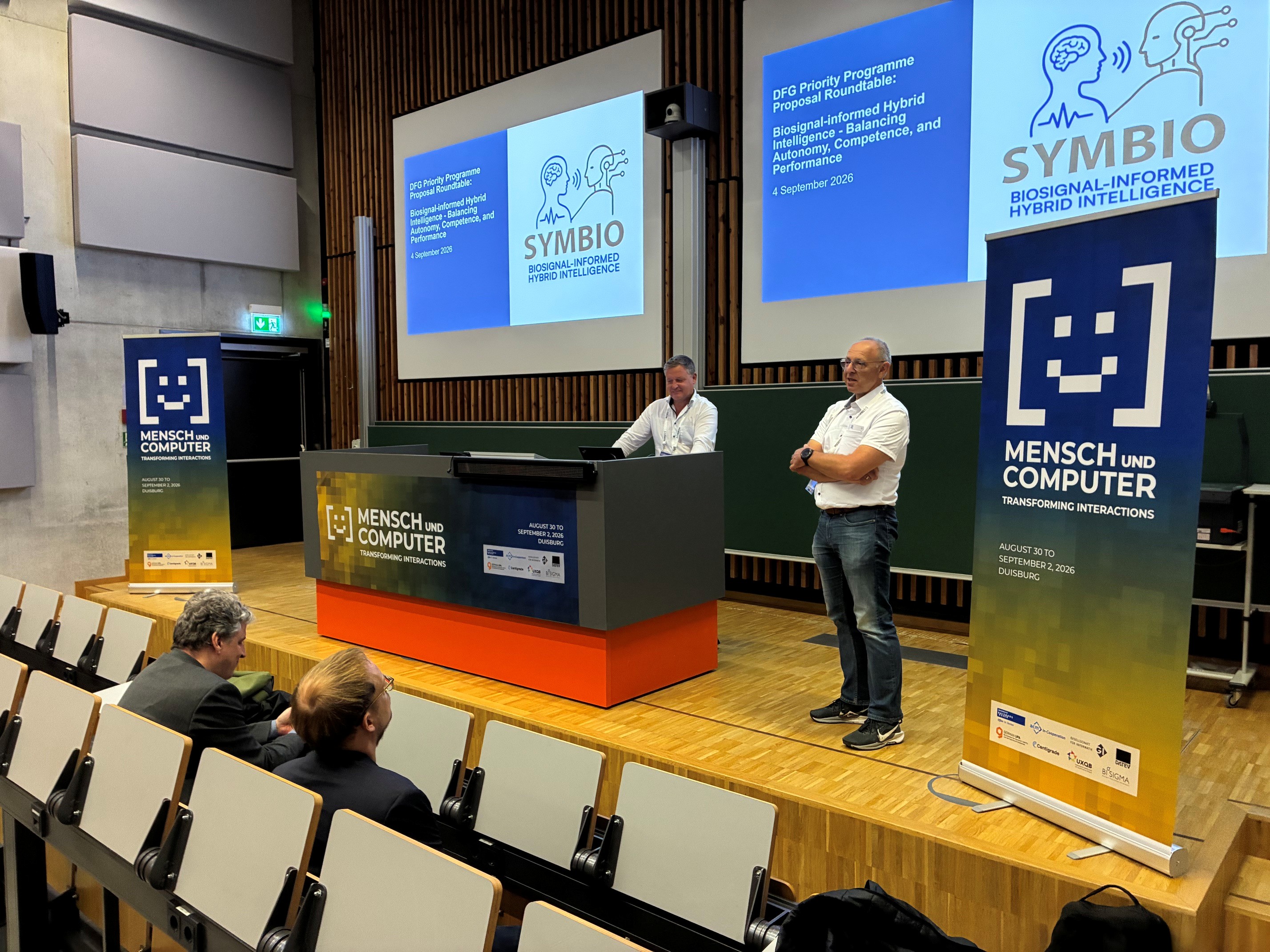
- Online Roundtable on Friday, 4 September, at 11:00 AM (register here): We invite you to a roundtable for the planned DFG Priority Programme proposal. The session will introduce the programme’s vision, research priorities, and opportunities for interdisciplinary collaboration We look forward to discussing the proposal with interested participants and gathering your perspectives and ideas.
- Proposal Submission on 15 October 2026
Activities carried out:
- Informal Networking Event on Monday, 31 August, at 15:30 PM in room LX1203 at Mensch und Computer 2026, University Duisburg-Essen