
Welcome
The Institute for Information Systems (WIN) was established on January 1, 2025 at the Karlsruhe Institute of Technology (KIT). The founding of the WIN Institute at KIT is a response to the growing importance of investigating and designing the digitalization of economy and society from a socio-technical perspective.
The mission of WIN is to create value from information! We strive for top-tier research in information systems and related fields, leveraging unique research infrastructures, strong community ties, and close collaboration with business, society, and politics to drive innovation. We deliver solutions for real-world problems, and inspire as well as challenge our students through research- and practice-based teaching.

SAP SE invites KIT students to the SAP Student Day, an exclusive onsite event at the SAP Headquarters that combines career insights, inspiring conversations, and a look behind the scenes. The event takes place on Friday, November 20, 2026 - starting at 10:00 a.m. in Walldorf. Learn more about career opportunities, AI, and learning options for students at SAP. Meet SAP employees, make connections, and join a guided campus tour. Further information is available here.
More
On October 19th 2026, Prof. Mädche handed over the three IS scholarships funded Schwarz Digits to the KIT information systems students Emilia Frey, Till Schreiner and Nils Menzel. For the 2026/27 period, seven information systems (IS) scholarships were awarded by the non-profit association "Die Wirtschaftsinformatik e.V." at Karlsruhe Institute of Technology (KIT) supporting students of the Information Systems program. The scholarship serves to promote young people, it runs for 12 months and supports scholarship holders with 300 Euros per month. The scholarship is funded by companies that provide the financial support.
More
The Institute for Information Systems (WIN) will be represented with 8 full papers at the International Conference on Information Systems, which will take place in December in Lisbon (Portugal) in 2026. Congratulations to all authors!
More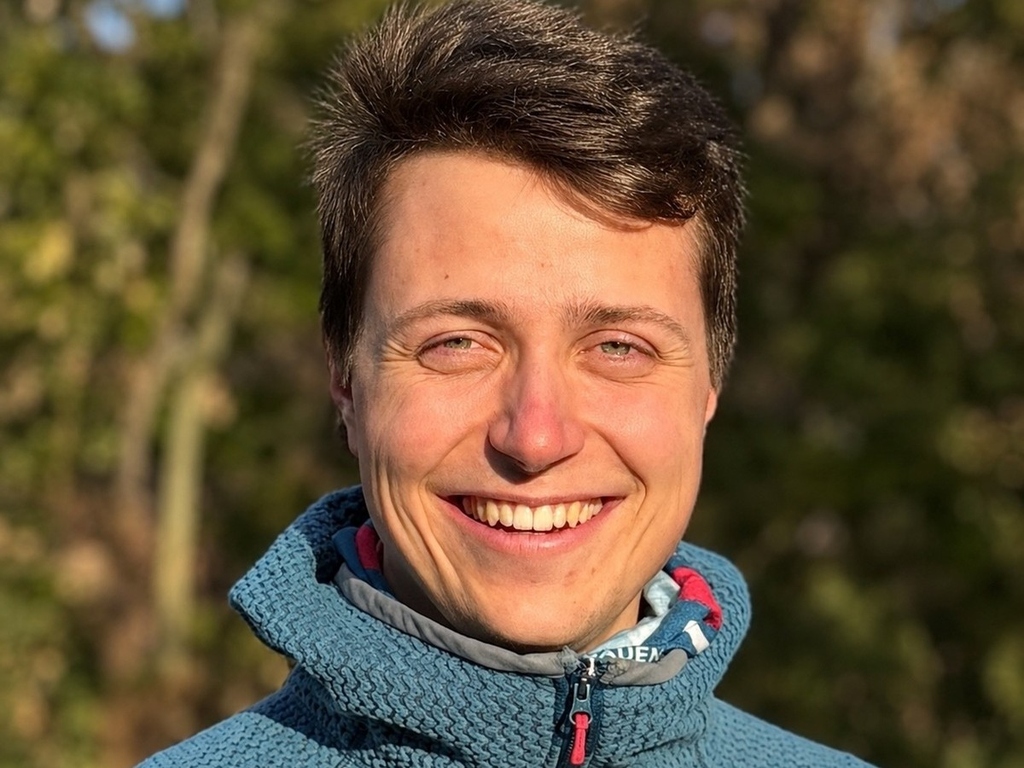
Maximilian Graf graduated from the DHBW Mannheim with a bachelor’s degree in Information System Engineering - Data Science and the Karlsruhe Institute of Technology (KIT) master’s in Information System Engineering. During his master’s, he focused on Artificial Intelligence and Software Engineering and worked as an AI engineer at SAP. He will focus on applying AI under uncertainty and designing human-ai interaction.
More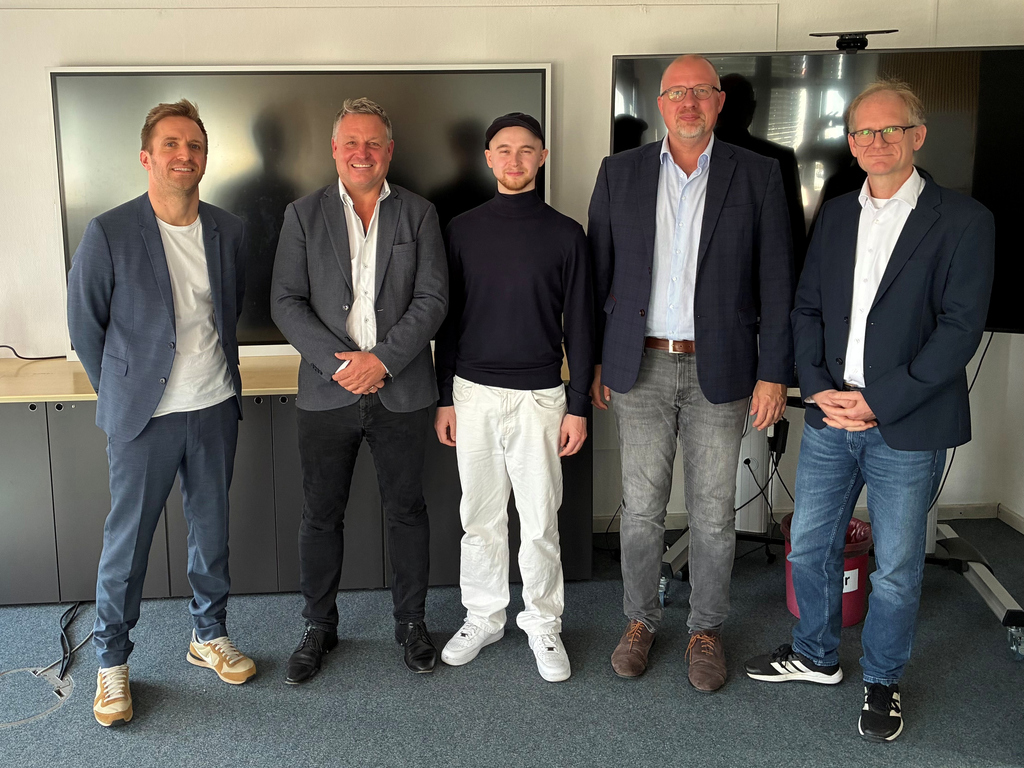
Leon Hanschmann successfully defended his PhD thesis, “Designing LLM-based Conversational Agents for Mental Health,” on October 12, 2026. His research advances digital mental health by exploring safe development and testing methods, the effects of compassion and embodiment on therapeutic outcomes, and user-centered design principles for conversational agents. We congratulate Leon on this achievement!
More
How can extended reality (AR and VR) make public participation in urban planning more accessible, more meaningful, and more engaging? A new article by Dr. Jonas Fegert and Prof. Dr. Jella Pfeiffer has been published in the European Journal of Information Systems (EJIS), one of the eight journals in the AIS Senior Scholars' Basket and among the leading outlets in the discipline. The article appeared in open access on 2 September 2026.
More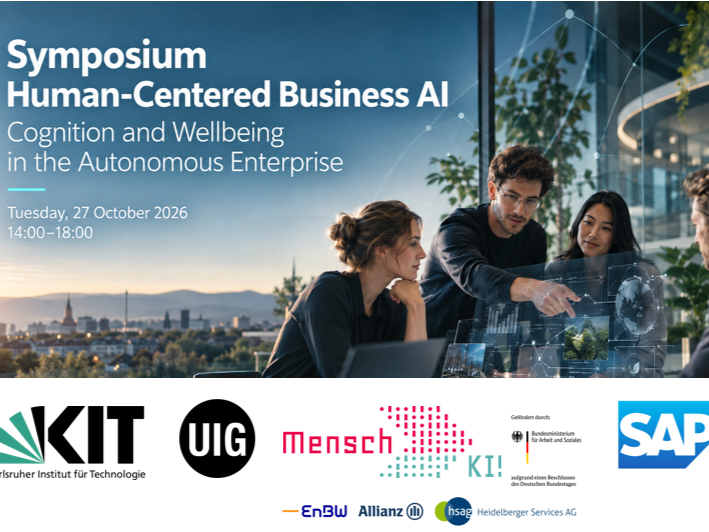
The Institute for Information Systems (WIN) is co-organizing the symposium “Human-Centered Business AI – Cognition and Wellbeing in the Autonomous Enterprise” with MenschKI! project partners and SAP on 27 October 2026 in Karlsruhe. The symposium explores how autonomous AI systems can balance performance with human cognition and wellbeing, featuring research talks, industry use cases, posters, and networking. Participation is free, with limited seats available.
More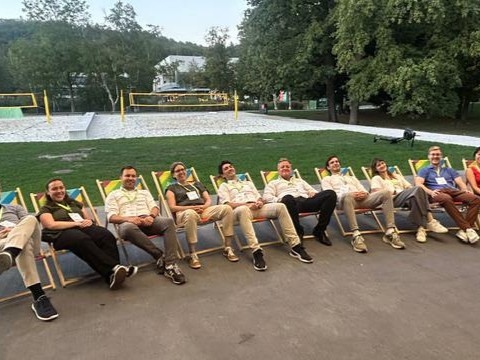
This week, our team attended WI2026 in Linz, Austria, bringing together researchers and practitioners from the Information Systems community to exchange ideas and discuss current developments. We thank the organizers at JKU Linz for a well-organized and inspiring conference. Next year, WI2027 will take place at KIT in Karlsruhe, with Calls for Tracks and Workshops already open.
More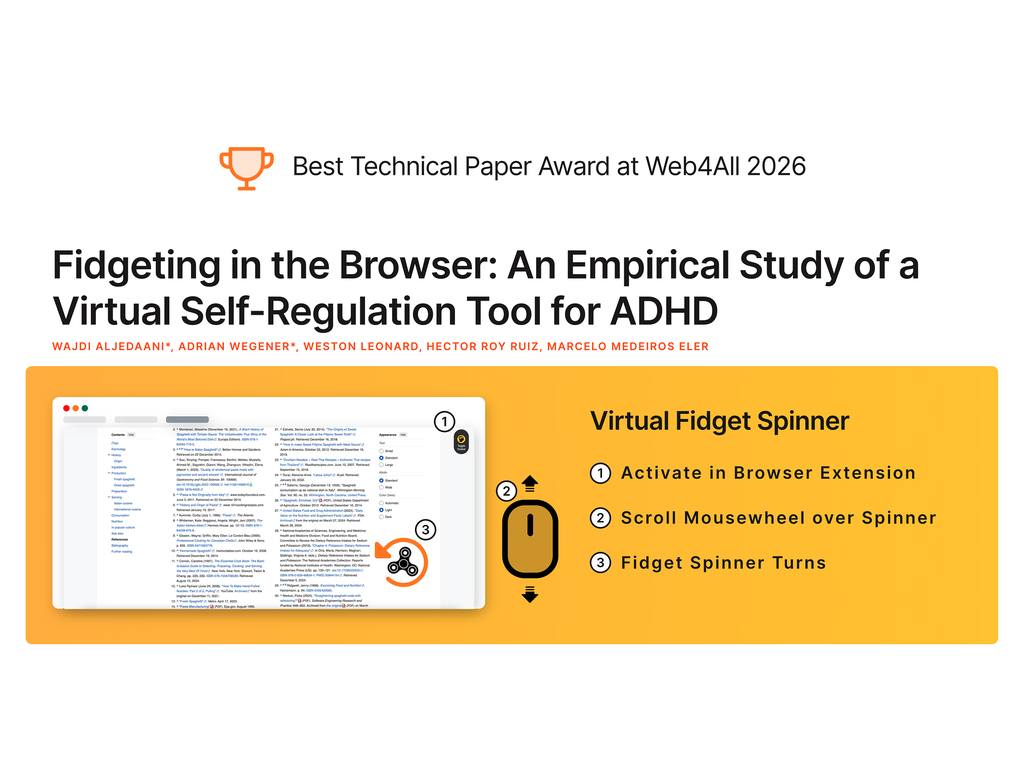
Research by Adrian Wegener from the human-centered systems lab (h-lab) in collaboration with colleagues from Brasil, Saudi Arabia and USA has received the Best Technical Paper Award at the 23rd International Web for All Conference (Web4All-2026). In their paper, “Fidgeting in the Browser: An Empirical Study of a Virtual Self-Regulation Tool for ADHD,” the team worked with people with ADHD in a co-design process to develop a virtual fidget spinner offered as a browser plugin.
More_rdax_98.png)
This industry-based doctoral position is offered in cooperation between the Human-Centered Systems Lab and Atruvia AG, the central IT and digitalization partner of the German Volksbanken and Raiffeisenbanken. The research focuses on innovative conversational banking solutions using agentic AI and knowledge graphs. The doctoral project is rooted in Information Systems, with interdisciplinary links to Human-Computer Interaction and Artificial Intelligence.
More
Svenja holds a B.A. degree in Business Administration from Hochschule Düsseldorf and an M.Sc. degree in Business Information Systems from the University of Göttingen. During her studies and her work as a student researcher, she gained experience in human-centered information systems research, particularly in the areas of human-AI interaction and digital well-being. In her master's thesis, she investigated how users make sense of algorithmically curated social media feeds in the context of food- and body-related content.
More
Starting this winter term, Prof. Jella Pfeiffer offers a new class that teaches research methods in information systems (Veranstaltungsnummer 2500075, Monday 2.00 pm - 5.15 pm). This class is helpful for all students who want to write a thesis or seminar in information systems in the WIN institute. The content is coordinated among all WIN-groups and therefore it will help all students, no matter in which research group they finally write their papers or thesis in.
More